
PhilHealth requirements 2026: what to bring, by member type
The first time I registered someone online, the portal bounced the application back twice. Not for a missing document. For a birth certificate photo it called “too dark,” with an error message that never explained what “too dark” meant. I reshot it by a window, resubmitted, and it cleared in ten minutes. That is the part nobody warns you about. The requirements themselves are short. It is the small stuff around them, a dim scan, a middle name that does not match, a box ticked wrong, that sends you back to the start.
On this page
- Quick answer
- The three documents nearly everyone needs
- Which requirements apply to you
- Requirements for a new member
- PhilHealth ID requirements
- Requirements to update or change status
- Valid IDs PhilHealth accepts
- A note on “accreditation” requirements
- What gets applications rejected
- Free process, and how fixers exploit it
- Quick answers
- Official sources
Quick answer
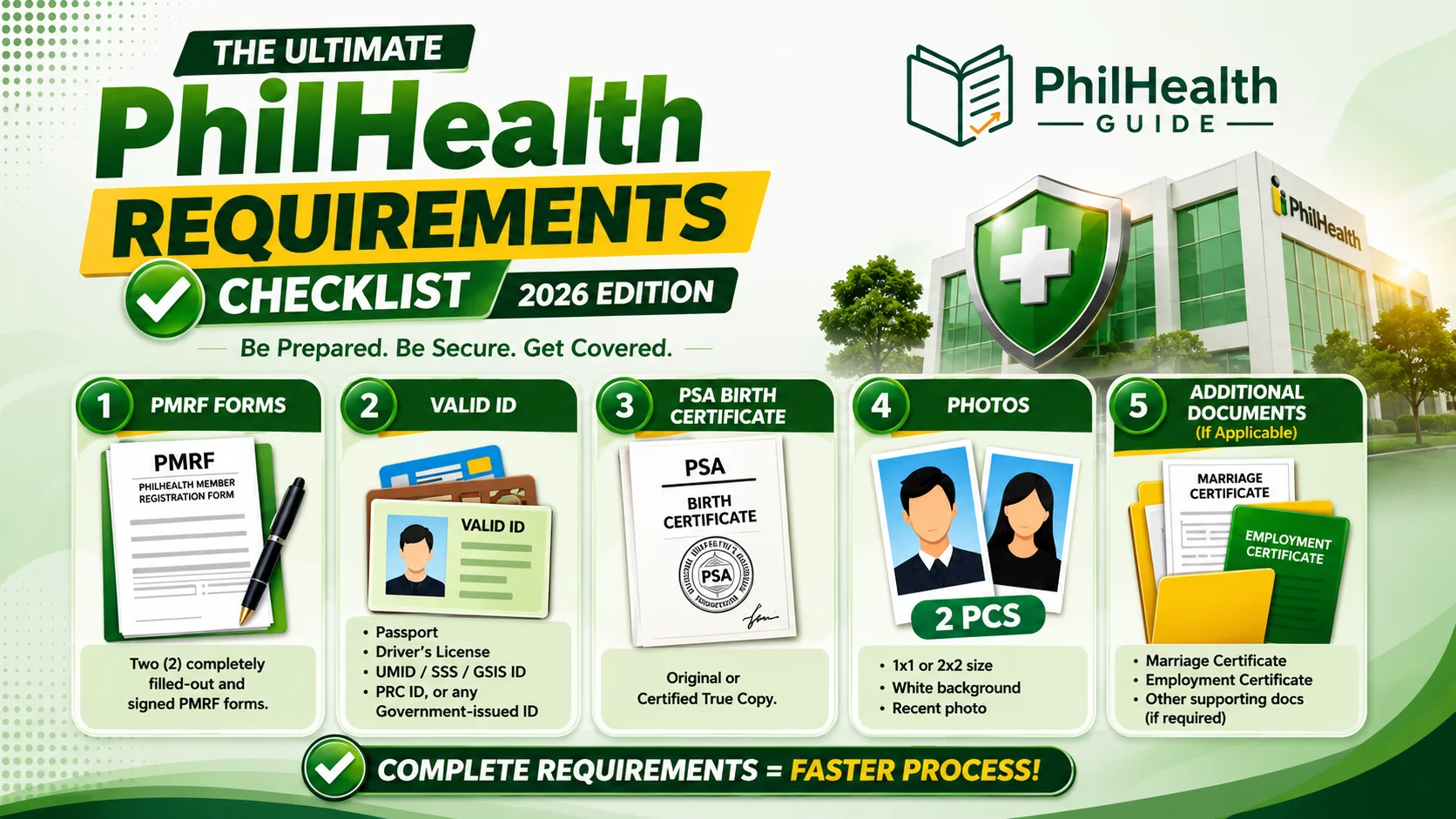
For most people, PhilHealth requires three things: a completed PhilHealth Member Registration Form (PMRF), one valid government ID with a photocopy, and a PSA birth certificate. Everything past that depends on your category. Employees add a company ID or Certificate of Employment, the self-employed add proof of income, OFWs add proof of overseas work, and seniors aged 60 and up just need an ID showing their birth date.
The three documents nearly everyone needs
Strip away the category-specific paperwork and almost every PhilHealth transaction rests on the same short list. Get these right and you have handled about 80 percent of what any branch or the online portal will ask for.
- The PMRF. One form covers new registration, updates, and ID requests. You just tick a different purpose at the top. Grab the current version from the PMRF form guide or straight from philhealth.gov.ph, and skip the copy that has been sitting in your phone’s downloads since 2022.
- One valid government ID, plus a photocopy. For a branch visit, bring the original too, since staff cross-check the copy against it.
- A PSA birth certificate. Mostly for first-time registration and for anything involving a name or birth-date correction.
Which requirements apply to you
This is where generic checklists fall over. They dump every possible document in one pile instead of telling you which ones are yours. Find your membership category in the table, and ignore the rest.
| Member type | Core form | What you add on top |
|---|---|---|
| Employed | PMRF (HR usually files it) | Company ID or Certificate of Employment, plus a valid ID |
| Self-employed / freelancer | PMRF, correct category ticked | Proof of income: DTI registration, Mayor’s Permit, OR/CR for drivers, or a notarized income declaration |
| OFW | Two copies of the PMRF | Overseas Employment Certificate (OEC) or a valid work contract, plus your passport |
| Voluntary / unemployed | PMRF, registered as voluntary | Valid ID and a declared monthly income to set your bracket |
| Student, under 21 | Parent’s PMRF or M2 form | Listed as a dependent: birth certificate or school ID, no separate premium |
| Student, 21 and over | Own PMRF, voluntary or self-earning | Valid school ID plus a birth certificate or primary government ID |
| Senior citizen (60+) | PMRF (first-timers only) | One valid ID with your birth date. Automatic coverage, no premium if not working |
| Indigent / sponsored | PMRF | DSWD or LGU certification if you apply directly rather than through automatic Listahanan inclusion |
On students specifically: a child under 21 rides on a parent’s coverage as a declared dependent and pays nothing. Once they turn 21 that ends, and they register on their own as voluntary or self-earning. FilipiKnow and a few other guides get the age cutoff right but bury it three sections deep. It is the whole answer for most parents, so it goes near the top here.
Senior coverage is automatic under Republic Act 10645, and all Filipinos became members by default under the Universal Health Care Act (RA 11223, 2019). Automatic membership is not the same as an active, usable record, though. If you have never appeared in the system, a first-time PMRF still gets you formally on the books.
Requirements for a new member
Never had a PhilHealth Identification Number (PIN) before? Registering as a brand-new member is the shortest version of this whole thing. Here is the full sequence.
- Fill out a PMRF and mark the purpose as “Registration,” not “Updating.”
- Bring one valid ID with a photocopy.
- Bring your PSA birth certificate.
- Add two recent 1×1 photos only if you want the physical ID card during the same visit.
You can also do all of this without leaving the house. The online registration guide walks through the e-Registration flow, where you upload the same documents and your PIN lands in your email instead of being written by hand at a counter. One practical warning for the online route: file quality is what trips people up, not the documents themselves. Shoot in daylight, get all four corners in frame, and keep the file small. That “too dark” rejection I mentioned at the top is the most common reason an upload gets bounced.
PhilHealth ID requirements
If you are after the physical card and not just the number, the list is short: your PIN, or a completed PMRF if you do not have a PIN yet, one valid government ID, and two recent 1×1 photos. Members who have simply never picked up their card follow the same list. No fresh registration needed. The PhilHealth ID guide covers the paper-versus-PVC card question and what actually happens at the branch when you claim it.
Requirements to update or change status
Updates reuse the same PMRF as registration. You mark the purpose as “Updating/Amendment” and attach one supporting document tied to whatever is changing. When the form has an old-info and new-info column, fill in both. PhilHealth wants to see the before, not just the after.
| What you’re changing | Document to attach |
|---|---|
| Adding a spouse | PSA marriage certificate |
| Adding a child | Child’s PSA birth certificate |
| Adding a parent as dependent | Their PSA birth certificate and a copy of their ID showing birth date |
| Correcting a name or birth date | PSA birth certificate, and a sworn affidavit in some cases |
| Employed to self-earning (or back) | Proof matching your new category, per the table above |
After any change, log back in and reprint your Member Data Record (MDR) to confirm it went through. The MDR is the record hospitals actually read at admission to check your status and your listed dependents. Do not assume an update landed just because you handed in the form. An undeclared dependent will not show on the MDR and cannot use your coverage until the update posts.
On maternity, the documents are only half of it. To claim maternity benefits you generally need a qualifying contribution record, commonly three monthly contributions within the six months before your confinement, on top of your MDR and proof of the pregnancy or delivery. Rules like this shift by circular, so confirm the current count on the maternity benefits guide and against PhilHealth’s own issuances before you rely on it.
Valid IDs PhilHealth accepts
Any one of these generally works as your valid ID across most transactions:
- PhilSys National ID
- Philippine passport
- Driver’s license
- UMID or SSS ID
- GSIS ID
- Voter’s ID or voter’s certificate
- Postal ID
- Senior Citizen or OSCA ID (for the senior category specifically)
No single ID is mandatory here. Bring whichever you have, as long as it is current and the name on it lines up with your PSA record.
A note on “accreditation” requirements
People searching “PhilHealth accreditation requirements” usually land in the wrong place, so worth clearing up: accreditation is for healthcare providers, not members. Hospitals, clinics, and individual doctors get accredited so PhilHealth pays for the care they give. If you are a member gathering documents to register or claim, accreditation is not something you apply for. What you want is registration and an active contribution record. If you are a provider, that process runs through PhilHealth’s own accreditation unit and is a separate track entirely.
What gets applications rejected
Same short list of culprits, again and again:
- A name that does not match your PSA birth certificate. The number-one rejection reason, and the easiest to overlook.
- An outdated PMRF. Redownload the current one every time instead of reusing an old file.
- No proof of income when you are self-employed or voluntary. Declaring nothing is not the same as declaring an amount.
- A blurry or dark upload on the online route. Reshoot in daylight before you resubmit.
- An old employer still tagged to your account because a status change never happened.
Lost your PIN somewhere in the middle of all this? Do not start a second registration, which creates a duplicate record that is a headache to merge later. The lost PhilHealth number guide covers the recovery route instead.
Free process, and how fixers exploit it
Why this guide exists
I write this from the member’s side of the counter, not PhilHealth’s. I have registered, lost and recovered a PIN, reprinted an MDR the night before an admission, and gotten a couple of these steps wrong the first time around. The requirements are not complicated. What is missing from most write-ups is the context that tells you which pieces are actually yours, so you are not the person at the window who researched carefully and still got sent home for one missing ID.
Quick answers
What are the basic PhilHealth requirements for a new member?
A completed PMRF marked “Registration,” one valid government ID with a photocopy, and a PSA birth certificate. That covers most first-time registrations, whether at a branch or online.
What are the PhilHealth ID requirements?
Your PIN, or a completed PMRF if you do not have a PIN yet, one valid government ID, and two recent 1×1 photos. Same list whether you are new or an existing member who never claimed the card.
What do self-employed members or freelancers need to register?
A PMRF with the self-earning category ticked, a valid ID, and proof of income. Proof can be a DTI registration, a Mayor’s Permit, OR/CR for drivers, or a notarized income declaration.
What are the requirements if I’m unemployed?
You register as a voluntary member with a PMRF, a valid ID, and a declared monthly income used to set your contribution bracket. No employer document is needed.
Do students need to register with PhilHealth?
Students under 21 are covered for free as dependents on a parent’s record, added through the PMRF with a birth certificate or school ID. At 21 they register on their own as voluntary or self-earning members.
What documents do senior citizens need?
Coverage is automatic under RA 10645, so first-timers generally need only a PMRF and one valid ID showing their birth date. Anyone already holding a PIN just updates their existing record.
What are the requirements to change my membership status?
Use the same PMRF marked “Updating,” fill both the old and new columns, and attach proof for your new category, such as a Certificate of Employment or proof of income. Reprint your MDR afterward to confirm it posted.
Are the requirements different for online registration?
The documents are the same, just uploaded as digital files. The catch is image quality: dark, blurry, or cropped scans are the most common reason an online application is flagged. Shoot in good light and keep files small.
What are PhilHealth accreditation requirements?
Accreditation applies to hospitals, clinics, and doctors, not members. If you are registering or claiming as a member, you do not apply for accreditation. You register and keep your contributions active.
Official sources
Verify before you act
- PhilHealth official website (philhealth.gov.ph) — forms, member portal, and current advisories
- PhilHealth issuances (circulars & advisories) — check here when a figure or rule may have changed
- PhilHealth membership and registration page — category definitions and eligibility
About this guide. PhilHealth Guide is an independent resource written from the member’s perspective. It is not affiliated with, operated by, or endorsed by the Philippine Health Insurance Corporation, and it is not medical or legal advice. Requirements are set by PhilHealth circulars and can change. For anything you plan to act on at an admissions desk, confirm the latest details on philhealth.gov.ph first.
Not sure which category is actually yours?
Sort that out first with the membership category guide. It is a lot faster than gathering a stack of documents and finding out at the counter that half of them were for someone else’s category.