Informal Economy PhilHealth: What It Means in 2026
I didn’t know I’d been registered as “Informal Economy” until I needed a contribution printout for a loan application and saw the label sitting above my name. I’d assumed freelancer meant some kind of gap in my coverage. It doesn’t, it’s just PhilHealth’s name for anyone whose premium isn’t deducted by an employer, which turns out to be where a lot of people with perfectly steady income actually sit.
On this page
Quick Answer
“Informal Economy” is one of PhilHealth’s membership categories for anyone who pays their own premium directly, because no employer deducts it from a payroll. It covers freelancers, self-employed professionals, business owners, OFWs, dual citizens, naturalized citizens, and qualifying foreign residents. It has nothing to do with being undocumented or unregistered, it’s simply PhilHealth’s label for members who are both their own “employer” and “employee” for contribution purposes. In PhilHealth’s own segmentation research on the sector, Informal Economy members actually outnumbered Formal Economy members nationwide.
What “Informal Economy” Actually Means at PhilHealth
PhilHealth sorts its members into Direct Contributors and Indirect Contributors. Direct Contributors pay their own premium, and that group splits into two: Formal Economy, where an employer deducts and remits it for you, and Informal Economy, where you handle the full payment yourself.
The name describes how you pay, not whether your work is legal, taxed, or documented. A tricycle driver, a private-practice lawyer, and an online seller with a registered business can all sit in the same Informal Economy category, despite having very different setups otherwise.
Who Qualifies
PhilHealth’s own member classification groups Informal Economy into six types:
- Migrant workers, including OFWs, whether documented or undocumented abroad
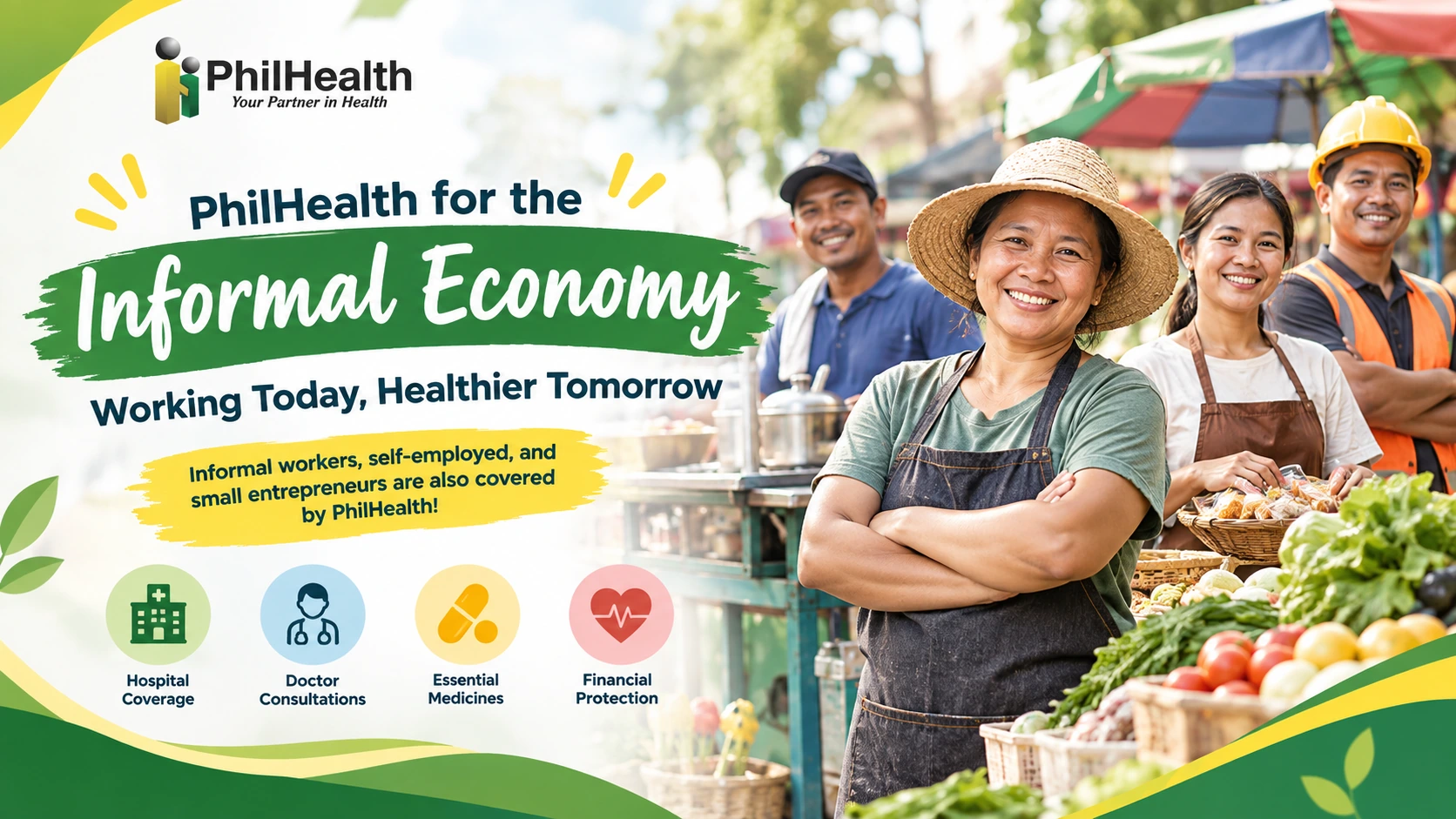
- Informal sector workers, like street vendors, market sellers, tricycle and pedicab drivers, small-scale construction workers, and home-based service providers
- Self-earning individuals and professionals, a broad group covering doctors, lawyers, engineers, architects, entrepreneurs, performers, athletes, coaches, and anyone selling goods or services outside an employer-employee relationship
- Filipinos with dual citizenship
- Naturalized Filipino citizens
- Qualifying foreign nationals working or residing in the Philippines with a valid Alien Certificate of Registration, enrolled under PhilHealth Circular No. 2017-0003
If none of these describe you but you also aren’t formally employed, check our membership category guide for the other categories, Sponsored, Indigent, Senior Citizen, and Lifetime Member work differently.
How Much You Pay
You pay 5% of your declared monthly income for 2026, the same rate as Formal Economy members, but you cover the full amount yourself since there’s no employer to split it with. The same floor and ceiling apply: income below ₱10,000 is still charged at the ₱10,000 rate, and income above ₱100,000 caps out at the same maximum.
| Declared monthly income | Monthly contribution |
|---|---|
| ₱10,000 or below | ₱500 (minimum) |
| ₱50,000 | ₱2,500 |
| ₱100,000 or above | ₱5,000 (maximum) |
Per PhilHealth’s official registration guidance, you can pay monthly, quarterly, semi-annually, or annually. Monthly payments are due by the last working day of the month they cover, quarterly and longer schedules are due by the last working day of the first quarter of the period being paid. Use our contribution calculator to work out your exact amount, and see our full contribution guide for payment channels.
Is the PhilHealth ID Different?
No. There’s no separate ID design or PIN format for Informal Economy members, it’s the same PhilHealth ID and PIN system used across every category. Your membership category shows on your Member Data Record, not on a different physical card.
Do You Get the Same Benefits?
Yes. Your PhilHealth benefits, including hospitalization case rates and maternity coverage, don’t change based on which category you’re in. What matters for any claim is whether your contributions meet the standard eligibility rule, generally three months of payments within the six months immediately before confinement, not which category label is on your record.
One genuine advantage worth knowing: declared dependents under your Informal Economy membership don’t add to your premium. Your spouse, children, and qualifying parents can be covered at no extra monthly cost once properly declared on your MDR.
How to Register
- Get two copies of the PMRF, available at any Local Health Insurance Office or PhilHealth Express outlet, or through the online registration portal.
- Mark “Self-Earning Individual” or the matching Informal Economy type under member classification.
- Declare your monthly income. Some branches ask for supporting proof, a DTI certificate, Mayor’s Permit, ITR, or a simple affidavit of income, though this isn’t always required at registration.
- Submit your PMRF with a valid government-issued ID. See our full requirements guide for the document checklist.
- Wait for your MDR and PhilHealth ID, then start paying your premium using your new PIN.
If your branch requires booking ahead, check our PhilHealth online appointment guide before heading in. Need a copy of your PMRF itself first? That guide covers where to get one.
How to Change From Informal to Formal
You don’t cancel your Informal Economy registration or apply for a new PIN. When you get hired, give your existing PhilHealth PIN to your new employer’s HR department, and they’ll process your enrollment under Formal Economy through their own remittance system. Your PIN and MDR stay the same, only your category and who’s paying updates.
What If You Lose Formal Employment?
The reverse works the same way. You keep the same PIN, you simply resume paying as an Informal Economy member once your employer stops remitting on your behalf. Submit an updated PMRF noting your new declared income, and try not to let too much time pass before your first payment, a long contribution gap can affect your eligibility if you need to file a claim before you’ve caught back up.
Mistakes to Avoid
- Assuming “informal” means something’s wrong with your coverage. It’s a payment category, not a reduced or informal level of benefits.
- Letting payments lapse after a job change. Gaps can cost you eligibility right when you might need to file a claim.
- Forgetting to update your PMRF after a status change. An outdated record can cause confusion at a branch or hospital desk later.
- Missing payment deadlines. Monthly contributions are due by the last working day of that same month, not the following one.
Frequently Asked Questions
What does “informal economy” mean in PhilHealth?
It’s PhilHealth’s membership category for Direct Contributors who pay their own premium because no employer deducts it, covering freelancers, self-employed professionals, OFWs, and a few other qualifying groups.
How to change PhilHealth from informal to formal?
Give your existing PIN to your new employer. They’ll enroll you under Formal Economy through their own payroll remittance, no new registration or PIN is needed.
What are examples of an informal economy member?
Tricycle drivers, market vendors, freelancers, private-practice doctors and lawyers, small business owners, OFWs, and qualifying foreign residents are all common examples under PhilHealth’s Informal Economy category.
Is there a separate PhilHealth ID for informal economy members?
No. Informal Economy members use the same PhilHealth ID and PIN system as every other category. Only the Member Data Record shows the category difference.
How much is the PhilHealth contribution for informal economy members?
5% of your declared monthly income for 2026, with a ₱500 minimum and ₱5,000 maximum, paid in full by the member since there’s no employer to split it with.
Do informal economy members get the same PhilHealth benefits as employed members?
Yes. Case rates, hospitalization coverage, and maternity benefits are identical across categories. What determines a claim is your contribution history, not your membership label.
If I lose my job, do I need to re-register with PhilHealth?
No. You keep your existing PIN and simply resume paying as an Informal Economy member by submitting an updated PMRF with your new declared income.
Not sure which membership category actually fits you?
Our membership category guide covers all six PhilHealth categories side by side, including Sponsored, Indigent, and Senior Citizen coverage.