PhilHealth Maternity Benefits 2026: Rates, Who Qualifies & How to Claim
A cousin of mine budgeted her whole delivery around a C-section figure she copied off a blog from 2023. By the time she was actually admitted this year, what PhilHealth pays had more than doubled, and the number she’d been quietly stressing over for months was just wrong. That is the situation right now. The rules changed hard in April 2026, and plenty of the amounts still floating around online are from the old system.
On this page
- Quick answer
- How much are the benefits in 2026?
- What each package covers
- How to qualify for PhilHealth maternity benefits
- Expanded maternity benefit vs. the 105-day leave law
- Benefits for employed members
- Benefits for unemployed moms
- How to apply and what to bring
- No balance billing: what you actually pay
- Frequently asked questions
Quick answer
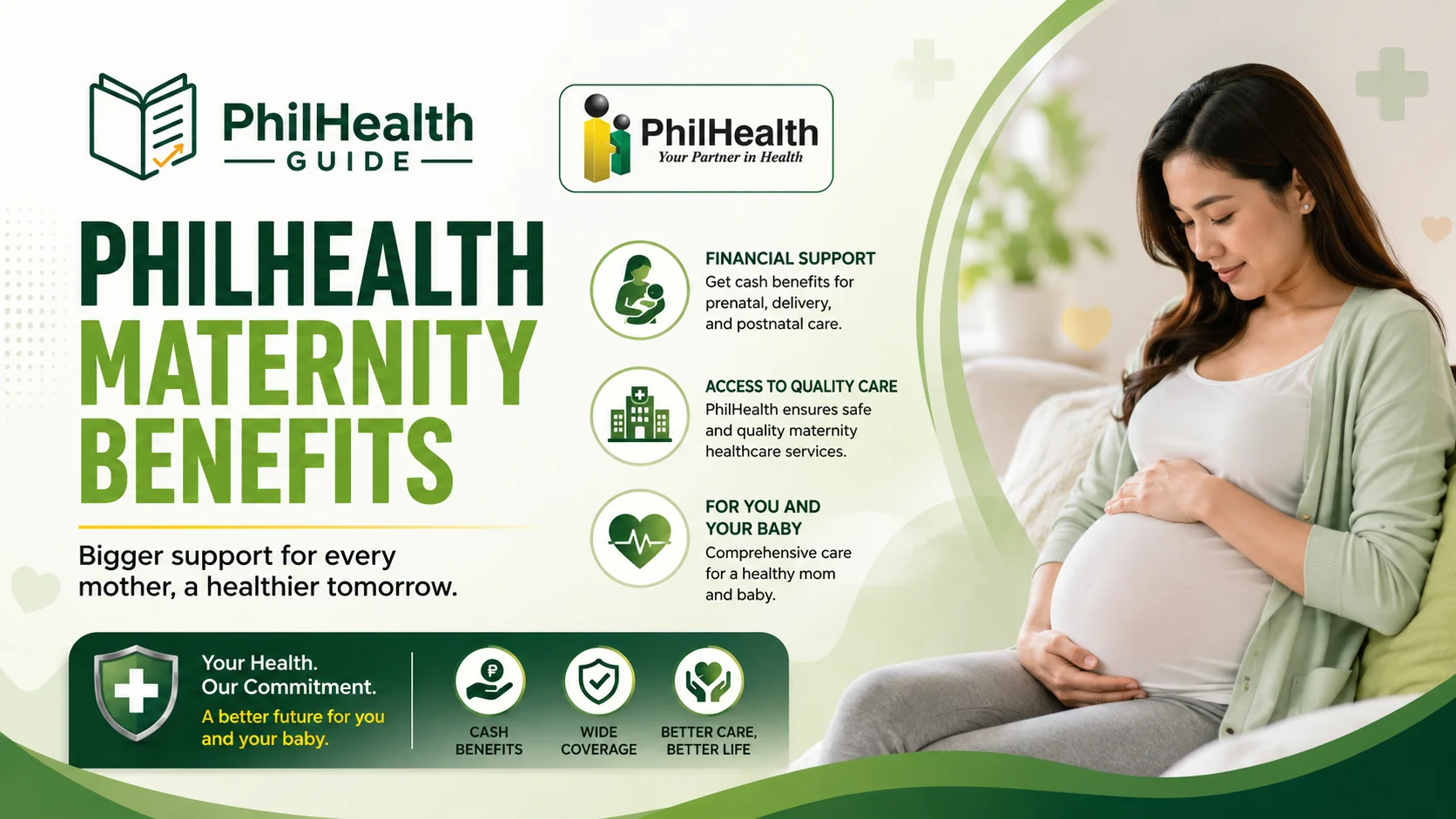
As of April 30, 2026, PhilHealth pays ₱29,000 for a normal hospital delivery and up to ₱62,000 for a medically indicated cesarean, both far above the old rates. Prenatal care now covers up to eight visits, three postnatal check-ups are included, and your baby gets a separate newborn package. To use any of it, your membership has to be active and you have to deliver at an accredited facility. This sits inside the wider PhilHealth benefits system, which is worth a read if you want the full picture.
How much are PhilHealth maternity benefits in 2026?
The April 2026 increase was big enough that old estimates are basically useless now. Two issuances did the work: PhilHealth Circular No. 2026-0005 covers deliveries in hospitals, and Circular No. 2026-0006 covers birthing homes and other outpatient facilities. Both took effect around the end of April 2026, confirmed in PhilHealth’s own circular archive and reported by the Philippine Information Agency.
| Package | Before April 2026 | 2026 (current) |
|---|---|---|
| Normal delivery, hospital (NSD) | ₱9,750 | ₱29,000 |
| Cesarean section (medically indicated) | ₱37,050 | ₱58,000–₱62,000 |
| Dilation & curettage (e.g. after miscarriage) | ₱21,450 | ₱36,500 |
| Normal delivery, birthing home / RHU | ₱6,500–₱8,000 | ₱14,000 |
| Prenatal visits covered | 4 | up to 8 |
If you want to sanity-check what you personally can expect at your income level, the contribution calculator is a quick way to see where you stand before you count on any of these figures.
What each maternity package covers
Normal spontaneous delivery
The old setup split this into two smaller payouts, the Maternity Care Package and the NSD Package, worth roughly ₱6,500 to ₱8,000 each. They are now one ₱29,000 package for a normal delivery at a DOH-accredited Level 1 to 3 hospital. It covers labor management, the delivery itself, and the immediate postpartum care before you go home. Deliver at a birthing home, lying-in clinic, or rural health unit instead, and the normal-delivery rate is ₱14,000 under Circular 2026-0006.
Cesarean section
A medically indicated C-section now pays up to ₱62,000, with the band starting around ₱58,000. Here is where I want to be straight with you: the press coverage and PhilHealth’s own summaries describe this as a range, and the most likely reason for the gap is hospital level, not whether it is your first or a repeat cesarean. So do not assume the exact figure until your hospital’s PhilHealth desk confirms it. Your doctor still has to document the medical reason for the surgery, because these case rate claims get reviewed.
Prenatal (antenatal) care
Prenatal coverage doubled from four visits to up to eight, and it now bundles in routine labs, ultrasound, vaccines, and vitamins, per the PIA reporting on the expansion. If you end up needing extra visits beyond the covered eight at a private provider, your out-of-pocket share is generally capped rather than open-ended, but confirm the current cap with the facility since this is new.
Postnatal care
For the first time, PhilHealth covers three postnatal check-ups: one within roughly 24 to 72 hours after birth, and follow-ups out to about six weeks postpartum. These exist to catch complications early, which is the whole point of the redesign.
Newborn care package
Your baby’s first-hours care runs on a separate package worth ₱5,752.50, according to PIA’s May 2026 report. It includes newborn screening, the newborn hearing test, the first hepatitis B dose, early skin-to-skin contact, and a basic health assessment. Worth knowing: the hearing test only pays out in full if the hospital actually performs it with proper equipment, not if someone just ticks a box.
Premature or small babies
If your baby arrives early or underweight, a different track applies. High-risk newborn and complication coverage sits under PhilHealth’s Z Benefits and related packages, which were not part of this April 2026 maternity expansion. Pregnancy complications like severe pre-eclampsia, eclampsia, and premature rupture of membranes are each listed at ₱8,840 in PhilHealth’s case rate annex. These specialized packages are usually only available at contracted tertiary or government hospitals, so ask before you commit to a facility if there is any chance you will need them.
How to qualify for PhilHealth maternity benefits
Start with the part that is settled. Under the Universal Health Care Act (Republic Act 11223), every Filipino is automatically a PhilHealth member. To actually use your maternity benefit, you need two things: an active membership record at the time you deliver, and delivery at a PhilHealth-accredited hospital or birthing facility so the case rate is deducted automatically.
The unsettled part is the exact contribution count, and I would rather tell you the truth than pick a confident number that turns out wrong at the admissions desk.
Not sure which membership category you fall under, or you have lost track of your PhilHealth number? Sort both out early. Doing it in your third trimester is how small gaps turn into stressful ones.
Expanded maternity benefit vs. the 105-day leave law
People mix these up constantly, so here is the clean version. The expanded maternity benefit is PhilHealth paying for the medical cost of your delivery and newborn care. The 105-Day Expanded Maternity Leave Law is about your salary while you are off work, and it runs through your employer and SSS, not PhilHealth. You will likely deal with both around the same time. They are separate systems, paid by separate agencies, and being covered by one does not affect the other.
PhilHealth maternity benefits for employed members
If you are formally employed, this is about as easy as PhilHealth gets. Your employer deducts and remits your contributions, and as long as those are current and posted, the hospital applies your case rate directly at admission. The one thing actually worth checking is whether your employer has been remitting on schedule. Delayed remittance by a company, rather than a missed personal payment, is a more common cause of “why isn’t my status active” than people expect.
You can verify this yourself by pulling your contribution history from the Member Portal ahead of time. Do not find out about a gap on the day you check in.
PhilHealth maternity benefits for unemployed moms
Not working right now? You are still reachable, you just carry the contributions yourself instead of an employer doing it. Register as a voluntary member and pay consistently through your pregnancy so your record is active before you deliver, since eligibility is judged on payments made before the birth, not after. Our online registration guide walks through becoming a voluntary member step by step.
How to apply for maternity benefits in PhilHealth
For most people at an accredited facility, “applying” barely involves you. The hospital checks your eligibility electronically at admission and deducts the benefit from your bill. There is usually no separate form for you to file afterward. Still, have these ready, especially if you are self-employed or an OFW:
- Confirm your membership is active and your contributions are posted through the Member Portal, ideally weeks before your due date.
- Print or save your Member Data Record (MDR), the document the hospital actually reads to confirm your status and dependents.
- Bring your PhilHealth ID or another valid government ID, plus proof of your latest contribution if you pay your own.
- Deliver at a PhilHealth-accredited hospital or birthing facility, and tell the admissions or PhilHealth desk you are a member so the deduction is applied.
If anything on your record is wrong, a misspelled name, an old address, or a dependent you still need to add, fix it through a PMRF update ahead of time, not the week you are due. Need a branch visit for any of it? Booking a PhilHealth online appointment first saves you a long queue, which matters a lot more at nine months pregnant.
No balance billing: what you actually pay
Stay in a basic or ward accommodation at an accredited facility and the No Balance Billing policy means the hospital generally cannot charge you beyond what PhilHealth already covers for included medicines, labs, and professional fees. With the higher 2026 rates, President Marcos said many ward deliveries, even in some private hospitals, can now come out to zero out of pocket for eligible members. Confirm that with your specific hospital’s billing office, because tertiary private hospitals often bill above the case rate even for a ward stay.
Choose a private room or upgraded services and you take on the difference on top of the case rate, usually as a fixed co-payment for a semi-private room.
Frequently asked questions
How much are PhilHealth maternity benefits in 2026?
₱29,000 for a normal hospital delivery and up to ₱62,000 for a medically indicated cesarean, effective around April 30, 2026 under Circulars 2026-0005 and 2026-0006. A normal delivery at a birthing home or rural health unit is covered at ₱14,000.
How do I qualify for PhilHealth maternity benefits?
You need an active membership when you deliver and you have to give birth at an accredited facility. The exact contribution count is reported inconsistently right now (nine-in-twelve, three-in-six, or relaxed under the UHC Act, depending on the source), so check your own standing through the Member Portal before your due date rather than assuming.
Can unemployed women still get PhilHealth maternity benefits?
Yes. Register as a voluntary member and pay your own contributions before delivery. If you have large gaps or never registered, the Point-of-Service program can provide sponsored coverage at admission in genuine financial-hardship cases, assessed by a medical social worker.
What is the difference between the expanded maternity benefit and the 105-day leave law?
They are separate. The expanded maternity benefit is PhilHealth’s medical coverage for delivery and newborn care. The 105-day law is your paid leave from work, handled by your employer and SSS.
Does PhilHealth cover prenatal and newborn care now?
Yes. Prenatal coverage doubled to up to eight visits with labs, ultrasound, vaccines, and vitamins, three postnatal visits are covered, and there is a separate newborn package worth ₱5,752.50 that includes newborn screening, the hearing test, and the first hepatitis B dose.
Can I get reimbursed for maternity expenses after giving birth?
Generally no. Unlike SSS or GSIS, PhilHealth’s maternity case rate is deducted directly from your hospital bill by the accredited facility, so there is usually nothing to file afterward.
Official sources
- PhilHealth official portal — check your status and confirm benefit details.
- PhilHealth 2026 circular archive — Circulars 2026-0005 and 2026-0006, the source of the maternity rates.
- Philippine Information Agency — government reporting on the April 2026 expansion.
Due date coming up?
Confirm your contribution status through the Member Portal now, not the week you are admitted. If anything on your record needs fixing, give it real time before delivery day.