
PhilHealth Contribution: Rate, Table & How to Pay
A friend of mine went freelance last year and figured she’d sort out PhilHealth “when she actually needed it.” Then she needed it, for a small day surgery, and the problem wasn’t the money. It was the empty months on her record. So before you’re standing at an admissions desk doing the math in your head, here’s how the contribution actually works.
On this page
- How much is the PhilHealth contribution?
- What your contribution actually is
- PhilHealth contribution table 2026
- How the amount is computed
- Voluntary & self-employed members
- How the rate changed from 2020 to 2026
- How to pay your contribution
- How to check if it posted
- What happens if you miss a month
- Quick answers
- Official sources
How much is the PhilHealth contribution?
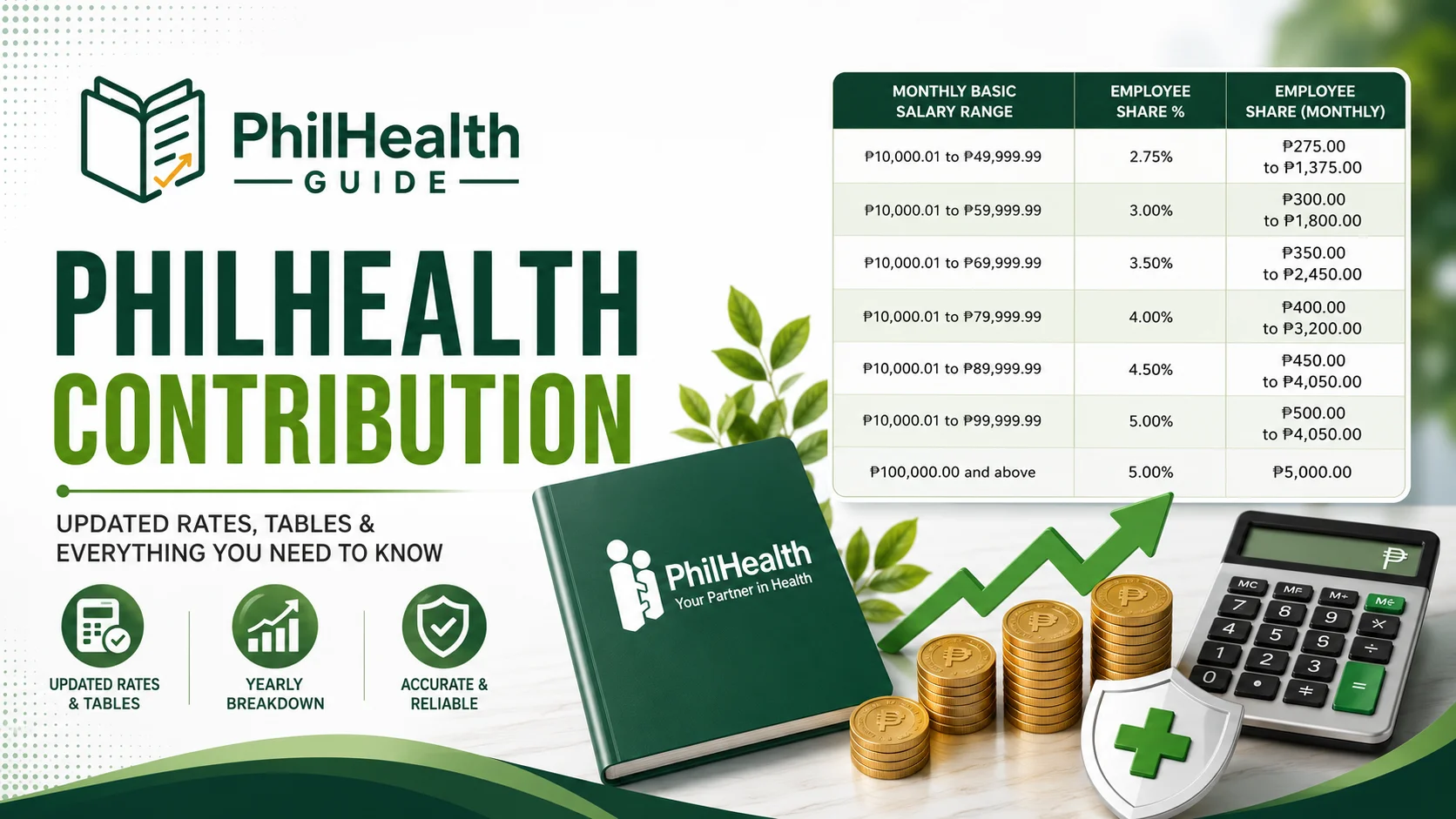
Short version: for 2026 you pay 5% of your monthly basic income, with a floor of ₱10,000 and a ceiling of ₱100,000. That puts the minimum at ₱500 a month and the maximum at ₱5,000. If you’re employed, you and your employer split it in half. If you’re self-employed or a voluntary member, the whole 5% is yours.
That 5% figure is the final rate under the Universal Health Care Act, and PhilHealth confirmed it stays in place for 2026. Earn below ₱10,000 and you’re still charged as if you earned ₱10,000. Earn above ₱100,000 and your contribution stops climbing at the ceiling. Nobody pays more than ₱5,000, whether they make ₱120,000 or a million.
What your contribution actually is
Your PhilHealth contribution is a monthly premium into the national health insurance fund. Everyone paying in shares one pool, and that pool is what covers hospital stays, surgeries, and treatments when a member gets sick.
It helps to be clear about one thing early: this is insurance, not savings. You can’t withdraw it, and there’s no running balance with your name on it waiting to be cashed out. What you’re buying is eligibility. Keep your record current and PhilHealth picks up part of your hospital bill when the time comes. That’s the whole deal.
The word “basic” also does a lot of quiet work here. The 5% applies to your monthly basic salary. Allowances, overtime, and bonuses don’t count toward the computation, which is why a ₱40,000 earner with a fat allowance still only pays on the ₱40,000 base.
PhilHealth contribution table 2026
Here’s the 2026 breakdown at common salary levels. The employee and employer columns apply if you’re formally employed. Voluntary, self-employed, and OFW members pay the full “total” column on their own.
| Monthly basic salary | Total premium (5%) | Employee share | Employer share |
|---|---|---|---|
| ₱10,000 and below | ₱500 | ₱250 | ₱250 |
| ₱15,000 | ₱750 | ₱375 | ₱375 |
| ₱25,000 | ₱1,250 | ₱625 | ₱625 |
| ₱40,000 | ₱2,000 | ₱1,000 | ₱1,000 |
| ₱60,000 | ₱3,000 | ₱1,500 | ₱1,500 |
| ₱80,000 | ₱4,000 | ₱2,000 | ₱2,000 |
| ₱100,000 and above | ₱5,000 (max) | ₱2,500 | ₱2,500 |
Rate and thresholds per RA 11223 (Universal Health Care Act), PhilHealth Circular No. 2019-0009 and Circular No. 2020-0005 (Rev. 1), retained for 2026 per PhilHealth’s advisory reported by the Philippine Information Agency.
Want your exact peso figure instead of reading off the nearest row? Our PhilHealth contribution calculator runs your real salary and membership type in a few taps.
How the amount is computed
The math is genuinely simple once you see it done. Take your monthly basic salary, keep it between the floor and ceiling, multiply by 5%. For an employee, halve the result for your payslip deduction.
- Retail clerk on ₱11,000: ₱11,000 × 5% = ₱550 total. As an employee, ₱275 comes off the payslip.
- Nurse on ₱9,000: below the floor, so it’s computed on ₱10,000. That’s ₱500 total, ₱250 from the payslip.
- Manager on ₱150,000: above the ceiling, so it’s capped at ₱100,000. That’s ₱5,000 total, ₱2,500 from the payslip.
Notice the floor and ceiling doing their job. The low earner isn’t charged less than the minimum, and the high earner’s premium levels off. Everyone in the middle just pays a clean 5% of what they actually make.
Voluntary & self-employed members
This is where a lot of freelancers get caught off guard. There’s no employer to split the bill, so you shoulder the full 5% of your declared monthly income yourself.
Picture two people both earning ₱30,000. The employee pays ₱750 from their payslip and the company covers the other ₱750. The freelancer earning the same ₱30,000 pays the whole ₱1,500. Same coverage, double the personal outlay. It stings the first time you run the numbers, but it’s the trade for being your own boss.
Not sure whether you’re voluntary, self-employed, or something else? The category you pick affects your paperwork and how your income is declared, so it’s worth getting right the first time. Our PhilHealth membership category guide walks through which one fits you.
How the rate changed from 2020 to 2026
If you’re squinting at an old payslip and the deduction doesn’t match today’s, that’s because the rate climbed on a schedule set under the UHC Act, and a couple of the increases got frozen along the way. Here’s what was actually charged each year, not just what was planned.
| Year | Rate charged | Floor | Ceiling | Min / Max |
|---|---|---|---|---|
| 2020 | 3.0% | ₱10,000 | ₱60,000 | ₱300 / ₱1,800 |
| 2021 | 3.0% | ₱10,000 | ₱60,000 | ₱300 / ₱1,800 |
| 2022 | 4.0% | ₱10,000 | ₱80,000 | ₱400 / ₱3,200 |
| 2023 | 4.0% | ₱10,000 | ₱80,000 | ₱400 / ₱3,200 |
| 2024 | 5.0% | ₱10,000 | ₱100,000 | ₱500 / ₱5,000 |
| 2025 | 5.0% | ₱10,000 | ₱100,000 | ₱500 / ₱5,000 |
| 2026 | 5.0% | ₱10,000 | ₱100,000 | ₱500 / ₱5,000 |
Compiled from PhilHealth’s published contribution schedule and reporting by Philstar and BusinessWorld. The 2021 and 2023 increases were suspended by presidential order, which is why the rate held flat those years.
The scheduled path was 2.75% in 2019 rising half a point a year to 5%. Reality was bumpier. The 2021 hike was suspended during the pandemic, so it stayed at 3%. The 2023 jump to 4.5% was deferred too, keeping it at 4%. Then 2024 skipped straight to the full 5%, and it has held there since. One thing worth knowing: PhilHealth judges your benefit eligibility against the rate in effect when a contribution was posted, not today’s rate, so an old payment still counts at its old value.
Reconciling old payments against your current record? Your Member Data Record (MDR) is the document that shows what posted and when, and it’s the same one a hospital reads at admission.
How to pay your contribution
If you’re employed, you don’t lift a finger. It’s deducted from your salary and your employer remits both shares. For everyone else, here’s the actual sequence:
- Log in to the Member Portal. You’ll need your PhilHealth Identification Number (PIN) and password. If you’re stuck at this step, our PhilHealth login guide covers the common snags.
- Generate a Statement of Premium Account (SPA). Under Payment Management, pick the months you’re settling. This is what tells the collecting partner the correct amount.
- Pick your channel. Most people pay through GCash or Maya via PhilHealth’s accredited collecting agent. Online banking and over-the-counter also work.
- Save the confirmation. Screenshot it and keep it. Posting can lag by a few days, and that receipt is your proof if anything goes sideways.
How to check if it posted
For a quick check, log in to the Member Portal and open “Premium Contributions.” That view shows which months are recorded against your PIN. It’s not an official document, just your own confirmation that the money landed where it should.
When you need proof for a bank, an embassy, or an employer who won’t accept a screenshot, request a Certificate of Contribution from a PhilHealth branch. That’s the official printed record of your payment history, and it’s a separate thing from the portal view.
What happens if you miss a month
Missing a month doesn’t cancel your membership. What it can affect is your access to specific benefits, because some coverage checks for a minimum number of recent contributions before it pays out.
Here’s the part a lot of guides get wrong: voluntary members generally can catch up on missed months. You generate an SPA for the unpaid period and settle it. It isn’t automatically forfeited. The catch is interest. Late payments for self-employed members, professionals, and land-based OFWs can carry charges of up to 1.5% per month, so waiting costs you. Employers who miss remittances face steeper penalties and legal exposure, which is why staying current matters more on the company side than the individual side.
Quick answers
How much is the minimum PhilHealth contribution in 2026?
₱500 a month. It applies to anyone earning ₱10,000 or below. Employed members split it, ₱250 each, while voluntary and self-employed members pay the full ₱500 themselves.
How much do self-employed members pay?
The same 5% rate as everyone, but in full since there’s no employer to share it. A freelancer declaring ₱30,000 pays ₱1,500, against the ₱750 an employee at that salary pays out of pocket.
Is there a maximum contribution?
Yes, ₱5,000 a month for 2026. Once your basic salary or declared income hits ₱100,000, the amount stops rising. Earning more than that changes nothing.
Does overtime or my allowance count toward the 5%?
No. The 5% is charged on your monthly basic salary only. Allowances, overtime, and bonuses are left out of the computation.
Why is my old contribution smaller than this year’s?
The rate was lower in earlier years, 4% in 2022 and 2023 and 3% in 2020 and 2021, with lower ceilings. It reached 5% in 2024 and has held there since.
Can I pay several missed months at once?
Voluntary members generally can. Generate an SPA for the specific unpaid months and settle them. Interest accrues on overdue amounts, so it’s cheaper to stay current than to catch up.
Not sure which number is yours?
Run your exact salary through our contribution calculator. It handles your membership type and gives you the precise peso amount faster than counting rows.
Official sources
- PhilHealth official website — advisories, circulars, and the Member Portal.
- Republic Act No. 11223, the Universal Health Care Act, which sets the premium schedule.
- PhilHealth Circular No. 2019-0009 and Circular No. 2020-0005 (Rev. 1) on the premium contribution schedule.
- Philippine Information Agency — government reporting on the 2026 rate.
About this guide. PhilHealth Guide is an independent resource written from the member’s side of the counter, not by PhilHealth. Everything here is checked against primary PhilHealth issuances and government reporting, and dated so you can see how current it is. Rates and rules change, so for anything you’re about to act on at a hospital or a branch, confirm it on philhealth.gov.ph first.